Port Logistics Modernization: Why Transfer Chute Failures Cause Costly Demurrage
In high-capacity dry bulk export terminals, ship loading rates dictate terminal profitability. With modern bulk carriers costing tens of thousands of dollars per day in port fees, any bottleneck that stops continuous material flow directly triggers astronomical demurrage penalties. Among the critical failure points in continuous bulk conveying systems, transfer chutes are the most susceptible to catastrophic abrasive wear and structural damage.
The Real Cost of Unplanned Chute Downtime in Port Logistics
Modern port terminals handle millions of tonnes of abrasive bulk materials annually-including iron ore, metallurgical coal, bauxite, and clinker. As materials drop from high-speed overland conveyors through vertical transitions, the kinetic impact and sliding abrasion rapidly destroy conventional sacrificial steel lining.
- Escalating Demurrage Fees: When a transfer point fails, vessel loading stops immediately. Demurrage costs accrue on an hourly basis while maintenance teams scramble for emergency repairs.
- Spillage and Environmental Fines: Chute wall punctures cause fugitive dust and massive material spillage, violating port environmental regulations.
- Safety Hazards of Hot Work: Emergency replacement of welded steel liners requires confined-space entry, cutting torches, and structural welding-introducing severe fire hazards and extended turnaround times.
Engineering Resilience: Ceramic Wear Solutions for Chutes
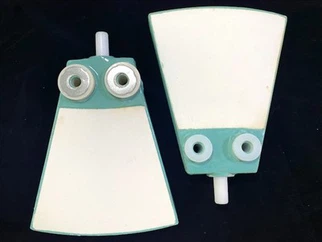
To eliminate unscheduled terminal shutdowns, modern bulk terminal operators are replacing conventional steel with high-performance Ceramic Wear Liners and Wear Liner Impact Plates Modules.
Our engineered 3-in-1 ceramic rubber engineered wear liner impact plates modules provide maximum protection for extreme mining and port terminal applications. By integrating 92%/95% Al2O3 high-purity alumina ceramic tiles, an energy-absorbing natural rubber matrix, and a structural steel backing, this composite configuration transforms brittle impact points into durable wear surfaces.
Key Engineering Advantages for Port Material Handlers
- Dual-Defense Mechanism: High-hardness alumina tiles withstand abrasive micro-cutting from sharp ore, while the vulcanized rubber cushion absorbs massive kinetic impact from high material drop heights.
- Bolted Wear Liners for Rapid Turnaround: Featuring factory-welded Grade 8.8 studs held to a precision tolerance of ±0.5 mm, these Quick Install and Removal Modular Liners enable fast mechanical changeouts without hot-work permits.
- Structural Flatness Integrity: Anti-deformation post-cooling ensures a surface flatness of ≤1.5 mm/m2, preventing fine-particle ingress behind the Lining Sheet.
Critical Wear Zones in Port Conveying Systems
Deploying specialized Extreme Abrasion Resistant Composite Ceramic Liners ensures reliable throughput across vulnerable transition assets:
- Ship loader telescopic spouts and deflector wear plates
- Stacker-reclaimer feed hoppers and boom conveyor transfer points
- High-drop overland conveyor discharge boxes and skirt boards
- Quayside grab bucket receiving hoppers
Upgrade Your Bulk Handling Reliability with ANDA Industrial
Eliminate premature chute failures and costly demurrage. Shandong ANDA Industrial Co., Ltd. engineers custom 2-in-1 and 3-in-1 Ceramic Wear Tile Systems tailored to your port's specific material velocity, trajectory, and impact requirements.
Contact our engineering specialists today at yulei@andaindustrial.com or call/WhatsApp +86 18753386785 to discuss your CAD drawings and wear mitigation requirements.