Asia LPDC Growth Market: Driving Automotive Lightweighting and Foundry Innovation
The global foundry sector is undergoing a rapid technological transformation, with the Asia-Pacific (APAC) region emerging as the primary powerhouse of the low pressure die casting (LPDC) market. Driven by surging electric vehicle (EV) adoption, stringent global fuel efficiency benchmarks, and massive capacity expansions in aluminum automotive wheel manufacturing, Asia commands more than 40% of the worldwide LPDC machinery and consumables volume.
Unlike conventional high-pressure methods, low pressure die casting utilizes smooth, laminar upward filling under precise pneumatic control (typically $0.2\text{ to }1.5\text{ bar}$), virtually eliminating turbulent gas entrapment and oxide inclusion defects. As automotive OEMs demand high-integrity, heat-treatable structural components-such as subframes, suspension knuckles, battery box crossmembers, and lightweight alloy wheels-Asia's LPDC foundries are scaling up automation and upgrading consumable refractory infrastructure to sustain continuous 24/7 production.
Macro Drivers Propelling Asia's LPDC Expansion
The acceleration of low pressure casting across Asian industrial corridors is propelled by three pivotal metallurgical and market forces:
- EV Fleet Weight Reduction & Structural Castings: Electric vehicles carry heavy battery packs, requiring aggressive chassis lightweighting to maximize driving range. LPDC provides the mechanical soundness and elongation properties ($A > 8\%$) necessary for safety-critical automotive parts.
- Relocation of Automotive Wheel Hub Hubs: Global alloy wheel manufacturing has concentrated in Asian hubs-particularly across China, India, Thailand, and Vietnam-where automated LPDC lines run hundreds of shots per shift.
- Transition to Automated Smart Foundries: Foundry operators are phasing out manual pouring and low-grade refractory conduits in favor of robotic cells, smart dosing furnaces, and durable technical ceramic melt-delivery systems.
Regional Growth Corridors: Where Asia LPDC is Concentrated
Understanding regional foundry landscapes allows tier suppliers, equipment makers, and consumable manufacturers to pinpoint market opportunities:
| Country / Corridor | Primary Casting Focus | Dominant Casting Alloys | Industrial Market Dynamics |
|---|---|---|---|
| Thailand (Chonburi, Rayong) |
Automotive alloy wheels, pickup chassis components, motorcycle engine heads | A356.2, AlSi7Mg, AlSi11 | The "Detroit of Asia"; heavy concentration of Japanese, Chinese, and joint-venture die casting facilities. |
| India (Pune, Chennai, Manesar) |
Two-wheeler alloy wheels, automotive knuckles, engine blocks | A356, LM25, AlSi9Cu3 | Rapidly expanding manufacturing hub; high demand for cost-effective, long-campaign refractory tooling. |
| Vietnam & Indonesia | Export-oriented aluminum wheels, motorcycle swingarms, structural brackets | A356, AC4CH | High influx of foreign direct investment (FDI) from international wheel makers establishing new casting lines. |
| Japan & South Korea | Precision EV battery trays, hollow-core subframes, premium OEM wheels | Advanced Al-Mg-Si alloys | Highly automated LPDC cells demanding tight dimensional tolerances and ultra-high component cleanliness. |
The Bottleneck: High-Temperature Consumable Reliability
As Asian foundries ramp up shot rates, the primary bottleneck shifting to center stage is melt-path downtime. In low pressure die casting, liquid aluminum is continually forced up a submerged feed conduit into the die. Legacy delivery systems using metallic cast iron stalks or low-grade refractories face severe operational limits under continuous $700^\circ\text{C}\text{ to }750^\circ\text{C}$ melt contact:
- Iron Leaching & Inclusion Scrap: Dissolving metallic tubes introduce brittle needle-phase iron impurities into aluminum-silicon alloys, causing structural wheel castings to fail impact testing.
- Oxide Scaling and Gate Freezing: Non-insulated channels pull heat from the melt, causing premature solidification at the die gate and requiring line stops to chisel away hard corundum dross.
- Pneumatic Pressure Leakage: Micro-cracking from rapid thermal shock causes holding pressure drop, resulting in unpredictable mold filling velocities and wall-thickness defects.
Industry Trend Insight: Leading LPDC wheel manufacturers across Asia are systematically replacing metallic and vacuum-formed fiber stalks with high-density silicon nitride (Si₃N₄) and aluminum titanate (Al₂TiO₅) riser tubes, extending stalk working life from weeks to over a year while slashing scrap rates by up to 25%.
Technical Ceramics: The Backbone of High-Availability LPDC Cells
To capture growth margins in Asia's competitive casting market, Tier-1 foundries are standardizing on integrated structural ceramic assemblies across the entire melt transfer cycle:
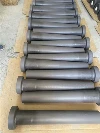
- Silicon Nitride Riser Tubes: High-density Si₃N₄ stalk tubes deliver ultra-high mechanical strength (> 600 MPa) and gas-tight sealing, resisting the mechanical clamp vibrations of high-speed LPDC machines.
- Aluminum Titanate Gating Cups & Stalks: Featuring near-zero thermal expansion and exceptional thermal insulation ($\approx 1.5\text{ W/m}\cdot\text{K}$), Al₂TiO₅ prevents gate freeze-off and eliminates molten aluminum adhesion without chemical coatings.
- Ceramic Flange Insulating Rings: Precision-ground silicon nitride rings insulate the furnace cover while evenly distributing bolt preloads, preventing premature stalk collar fracture.
- Submerged Thermocouple Sheaths: Non-wetting ceramic tubes provide rapid, lag-free temperature feedback to holding furnace burner loops, stabilizing melt liquidus consistency.
Partnering with Shandong Anda Industrial in the APAC Region
As the Asian casting sector expands, Shandong Anda Industrial Co., Ltd. serves as a direct manufacturing partner to foundries seeking dependable, OEM-grade ceramic consumables. Operating from our 10,000㎡ advanced manufacturing center in Zibo, Shandong Province-the core of China's technical ceramics industry-and backed by 15 years of international B2B export expertise, we supply precision-engineered molten metal handling components across Asia and worldwide.
Our portfolio includes high-density silicon nitride riser tubes, thermal-insulating aluminum titanate dosing tubes and gating cups, degassing rotors, and thermocouple protection tubes. Backed by our dedicated 6-engineer technical team, every component undergoes strict dimensional CMM verification, thermal shock benchmarking, and hydrostatic pressure testing to ensure immediate drop-in compatibility with global LPDC equipment.
Upgrading your LPDC cells or expanding capacity in Asia? Contact our technical sales engineering team today to review your furnace drawings, evaluate replacement economics, and secure factory-direct B2B quotations.