Global Coal Terminal Operations Demand Resilient Impact Wear Liners to Minimize Spillage
Application: Coal Export Terminals, Stacker-Reclaimers, High-Capacity Transfer Chutes
1. The Coal Terminal Bottleneck: Material Degradation and Costly Spillage
Global export coal terminals handle tens of thousands of tonnes per hour across complex belt conveyor networks, stacker-reclaimers, and high-throughput shiploaders. At critical material transfer points, high-velocity bulk coal encounters steep trajectories, drop heights exceeding 10 to 15 meters, and acute impact angles. Under these conditions, the kinetic energy of lump coal and abrasive rock impurities creates rapid localized gouging and wear patterns.
When conventional sacrificial steel liners wear out prematurely, chute geometry deforms. This induces turbulent material flow, skirt board seal failures, and severe coal spillage. Beyond the environmental penalties and fugitive dust compliance risks, bulk spillage results in direct tonnage loss, structural belt misalignment, and substantial cleanup costs that disrupt strict vessel-loading demurrage schedules.
2. Limitations of Conventional Lining in High-Drop Transfer Zones
Historically, coal handling facilities have relied on quenched and tempered steel plates (such as AR400/500) or pure ultra-high-molecular-weight polyethylene (UHMW-PE) liners. However, these traditional materials face distinct mechanical failure modes under modern port operating volumes:
- Rapid Gouging and Thinning: While coal itself exhibits moderate abrasive characteristics, run-of-mine (ROM) coal frequently carries sharp silica, pyrite, and shale contaminants that score and cut through conventional steel at high velocity.
- Deformation-Induced Seal Blowouts: Steel liner plates warp and deform under cyclic point loads, opening gaps between the liner face and skirt-board rubber seals. Material fines immediately escape through these gaps, causing continuous spillage along the loading zone.
- Catastrophic Impact Cracking of Rigid Liners: Pure ceramic tiles lacking elastic backing cannot survive continuous drop impacts from large coal lumps, leading to premature brittle fracture and tile detachment.
3. Resilient Engineering: The Dual Defense of 3-in-1 Composite Wear Liners
To establish continuous, leak-free material flow, terminal operators are retrofitting critical transitions with Ceramic Wear Liners specifically engineered for high-energy impingement zones.
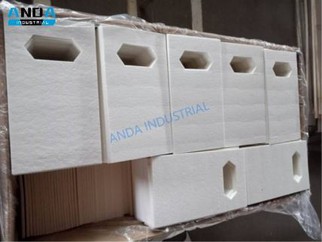
Our 3-in-1 ceramic rubber engineered wear liner impact plates modules provide maximum protection for extreme mining and coal terminal applications, effectively eliminating structural wear and preventing skirt-line spillage.
3.1. Elastomeric Kinetic Energy Dissipation
The core mechanism of a resilient composite liner lies in its specialized, high-resilience natural rubber formulation. The thick elastomeric layer acts as a mechanical spring, decelerating falling bulk materials and absorbing up to 80% of kinetic shock loads. By cushioning the impact, the rubber preserves the high-purity alumina ceramic face from micro-fracturing while mitigating shock transmission to the transfer chute frame.
3.2. Low-Friction, High-Hardness Technical Ceramic Face
The contact surface incorporates high-purity ($92\%$ or $95\%$ $Al_2O_3$) sintered alumina ceramic tiles with a Rockwell hardness of $\ge 85\text{ HRA}$. The low surface friction coefficient of smooth technical ceramics promotes laminar, uninterrupted material flow, preventing dead-bed build-up, plugging, and localized material back-ups that drive spillage over chute walls.
4. Technical Performance Matrix for Coal Chute Applications
| Engineering Parameter | Standard Specification | Impact on Spillage & Terminal Throughput |
|---|---|---|
| Ceramic Hardness (Rockwell) | ≥ 85 HRA | Maintains smooth, consistent flow lines over years of service |
| Rubber Matrix Tensile Strength | ≥ 18 MPa | Prevents matrix tearing under continuous high-mass coal drops |
| Rubber-to-Steel Peel Strength | ≥ 12 N/mm | Eliminates delamination caused by severe lateral shear forces |
| Liner Surface Flatness | ≤ 1.5 mm/m2 | Ensures a tight seal against skirtings to stop fines leakage |
| Fastening Method | Grade 8.8 Welded Studs (±0.5 mm tolerance) | Enables fast bolt-on installation without thermal cutting or welding |
5. Preventing Spillage Across Strategic Terminal Assets
Deploying specialized Bolted Wear Liners and modular impact plates stabilizes material trajectories across several key high-wear zones:
- Transfer Chute Impact Beds: Absorbs perpendicular drop loads from incoming tripper cars and conveyor head pulleys, centering the material stream onto receiving belts.
- Conveyor Skirt-Board Zones: Forms a rigid, perfectly aligned wear wall that holds skirting rubbers flush against the belt, eliminating edge spillage and belt grooving.
- Shiploader Telescopic Spouts & Deflectors: Ensures smooth, high-velocity directional flow during vessel trimming without build-up or sudden discharge blockages.
Engineered Bulk Material Handling Solutions | Shandong ANDA Industrial Co., Ltd.
Shandong ANDA Industrial Co., Ltd. manufactures heavy-duty 2-in-1, 3-in-1 Extreme Abrasion Resistant Composite Ceramic Liners, pulley lagging, and wear-resistant components tailored to port logistics and coal terminal CAD requirements.
Headquarters: Shiji Center, Liuquan Rd, Zhangdian Dis, Zibo, Shandong Province, China
Direct Engineering Inquiries: yulei@andaindustrial.com
Tel / WhatsApp: +86 18753386785
B2B Web Portal: www.andaindustrial.com