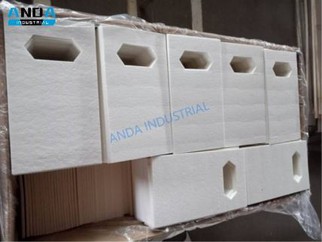
The riser tubes in low-pressure casting need to be in prolonged contact with high-temperature molten metals, such as aluminum alloys or magnesium alloys, with temperatures possibly exceeding 700°C. The material must be capable of withstanding such high temperatures and resisting the erosion of the molten metal. Additionally, the riser tubes undergo temperature changes in each casting cycle, so thermal shock resistance is crucial to prevent cracking due to thermal stress. The advantages of ALUTIT aluminum titanate rister tube include excellent thermal shock resistance due to its low coefficient of thermal expansion, making it less prone to cracking during temperature fluctuations. However, its disadvantages may include lower mechanical strength compared to NBSIC silicon nitride bonded silicon carbide rise tube, or potential structural degradation after long-term use at high temperatures. ALUTIT aluminum titanate rister tube may react when in prolonged contact with certain molten metals, such as magnesium-containing aluminum alloys. In contrast, NBSIC silicon nitride bonded silicon carbide riser tube may be harder, more wear-resistant, have better corrosion resistance, and good chemical stability, especially when facing certain more corrosive metals or alloys. This is because the thermal expansion coefficients of silicon carbide and silicon nitride may be low, but when combined, they offer better thermal shock resistance.
In terms of mechanical strength, the riser tube may need to withstand certain pressure or mechanical shock, especially under high pressure. Although the pressure in low-pressure casting is relatively low, structural stability is also very important. ALUTIT aluminum titanate rister tube has good thermal shock resistance, but its mechanical strength is relatively low and it is prone to damage under mechanical stress or high pressure. In contrast, NBSIC silicon nitride bonded silicon carbide rise tube has high strength and wear resistance, with high hardness, making it suitable for environments with high mechanical loads or wear.
 VS
VS 
Comparison:
Selection of ALUTIT aluminum titanate rister tube:
Frequent start-stop cycles or severe temperature fluctuations: such as in intermittent production, thermal shock resistance is prioritized.
Low pressure and low mechanical load: to avoid damage caused by high mechanical stress.
Limited budget: aluminum titanate has a lower cost and is suitable for cost-sensitive projects.
Selection of NBSIC silicon nitride bonded silicon carbide rise tube:
Continuous high-temperature operation: such as in long-term casting, material durability and chemical stability are required.
High mechanical load or corrosive environment: for example, in casting high-silicon aluminum alloys or scenarios requiring high wear resistance.
High demand for service life: despite the high initial cost, the long service life may reduce the overall cost.
NBSIC Silicon nitride-bonded silicon carbide risers are usually more suitable in low-pressure casting, especially in scenarios where high strength, corrosion resistance and long service life are pursued. However, if the process emphasizes frequent temperature changes and low mechanical load, aluminum titanate can be an economical alternative.