Applications of Ceramic Filter Plates in Mining Water Treatment | ANDA Industrial
Applications of Ceramic Filter Plates in Mining Water Treatment
Global mining operations are facing a critical water crisis. With mineral processing plants consuming up to 250 to 1,500 gallons of fresh water per ton of ore processed, and local governments imposing strict zero-liquid discharge (ZLD) mandates, water management has become a major operational cost driver. In 2026, global mineral processing lines can face up to $500,000 in regulatory non-compliance penalties annually if they fail to recycle process water or manage sub-micron mineral slimes effectively.
To mitigate these heavy overheads and eliminate large secondary tailings ponds, processing facilities are re-engineering their filtration loops. High-tonnage mineral processing plants are moving away from traditional thickeners and high-wear belt presses, choosing instead to implement advanced vacuum ceramic disc filter technology. This system relies on high-grade ceramic filter plates to maximize water recovery right at the underflow line.
[ WATER CRISIS ] Soaring Intake Costs + Strict Zero-Liquid Discharge Rules
│
▼
[ CIRCUIT RE-DESIGN ] High-Capacity Vacuum Ceramic Disc Filters
│
▼
[ RESOURCE RECOVERY ] Ultra-Pure Recycled Water (SS < 20 mg/L) + Stable Dry Cakes
For a comprehensive engineering analysis on optimizing hydraulic flow rates, managing slurry chemistry, and calculating fluid velocity across microporous substrates, read our flagship technical resource: The Complete Guide to Ceramic Filter Plates in Mining Filtration: Engineering, Optimization, and Global Trends.
1. The Challenge of Closing the Loop: Why Fabric Media Fails
Sustaining a closed-loop mining water treatment system requires a continuous, reliable method for removing sub-20 micron ultra-fine clays and suspended solids from processing circuits.
Traditional textile-based filter cloths struggle under these demands. Because fabric media features a flexible, variable weave, fine mineral slimes easily penetrate and lodge deep inside the multi-filament threads. This deep-bed particle blinding restricts water recovery rates and causes frequent cloth tearing, necessitating complete plant shutdowns every 100 to 250 operating hours for manual cleaning or media replacement.
The significant cost variations, service lifespans, and performance trade-offs of these materials are fully detailed in our technical analysis: Ceramic Filter Plates vs Filter Cloth: Which Is Better for Mining Filtration?.
2. Technical Principles: How Ceramic Filter Plates Purify Process Water
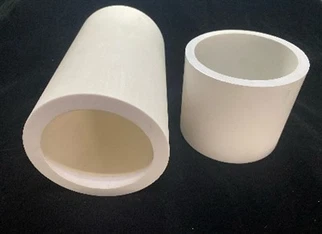
An industrial ceramic filter plate (also known as a ceramic filters disc) completely re-engineers fluid dynamics by combining controlled capillary forces with subsurface vacuum extraction.
Sub-Micron Asymmetric Separation
High-performance plates feature a specialized asymmetric design: a thin, top membrane layer with uniform pore matrices ($0.5 \sim 2.0\,\mu\text{m}$) bonded directly to a highly permeable porous substrate. This structure acts as a strict surface filtration barrier, isolating sub-micron mineral slimes on the outer face while allowing water to pass through freely.
Gas-Barrier Capillary Sealing
When wetted ceramic segments are submerged in the wastewater basin, the tiny pore radii generate high natural capillary tension. When an internal vacuum pump applies a deep negative pressure of -0.09 -0.098MPa, water molecules flow through the membrane matrix with ease.
Crucially, because the breakthrough pressure of these water-filled micropores is significantly higher than the applied vacuum pressure, air cannot pass through the ceramic membrane. The wetted pores remain completely sealed against air leakage. This prevents air bypass and concentrates the vacuum force entirely on fluid extraction, reducing total energy use by up to 80% to 85% compared to traditional cloth-based systems.
Advanced Water-Casting Architecture
To manage the heavy liquid volumes required during intensive mining filtration and tailings processing, modern plates rely on innovations like the Water Casting Process. Developed within Zibo's advanced industrial ceramic engineering hub, this method uses single-body molding and single-body sintering to create a robust, highly porous internal network where 80% of the entire plate volume consists of active drainage channels. This design lowers internal fluid resistance, speeds up water removal, and prevents internal delamination during high-pressure backwashing cycles.
3. Key Applications in Modern Mining Circuits
Integrating automated vacuum ceramic filters across a plant's water circuits delivers clear, measurable performance advantages:
- Closed-Loop Thickener Underflow Management: Placing a ceramic disc filter immediately downstream of primary thickeners allows operations to quickly extract clean water from heavy underflow slurries, minimizing environmental liabilities and facilitating dry tailings stacking.
- Ultra-Clear Recycled Water Production: The sub-micron surface membrane filters out fine slimes, yielding a recovered filtrate with exceptionally low total suspended solids (SS < 20mg/L). This clear water can be cycled directly back into the plant's milling, grinding, and flotation circuits without secondary clarification.
- Universal Equipment Fleet Compatibility: Sourced replacement plates are engineered to precise physical dimensions, allowing them to serve as high-performance aftermarket parts for major global filter brands such as Roxia and CEC.
4. Driving Cost Efficiency and Compliance: The TCO Advantage
For modern mining operations looking to optimize operating costs (OPEX) while meeting strict environmental standards, efficient process water recovery is an operational priority. Choosing high-performance alumina or silicon carbide ceramic filter plates helps processing plants ensure reliable throughput, low maintenance overheads, and dependable water reuse for long-term sustainability.
| Dewatering Metric | Traditional Filter Cloth | ANDA Water-Cast Ceramic Plates |
|---|---|---|
| Energy Consumption | High (10-15 kWh/t) due to continuous air compression | Extremely Low (1.5-3kWh/t) via gas-barrier sealing |
| Media Lifespan | Short (300 to 800 hours; prone to tears) | Long-lasting (15,000 to 30,000+ hours; 3-5+ years) |
| Filtrate Purity ($SS$) | Poor (>500mg/L); requires secondary thickeners | Ultra-clear (<20-mg/L); direct loop reuse ready |
| Equipment Fitment | Frequent tracking adjustments required | 100% Seamless drop-in match for Roxia & CEC fleets |
Upgrade Your Dewatering Infrastructure with Zibo's Advanced Engineering
Are you looking to cut your plant's filtration energy bills by up to 80% while maximizing water recovery rates? ANDA Industrial delivers high-performance, single-body sintered ceramic filter plates tailored for heavy mineral matrices. With our state-of-the-art multi-kiln facility running at full capacity, we ensure shorter lead times and premium component reliability for your global fleet.
Explore exact technical drawings, material options (Alumina vs. SiC), and custom compatibility data sheets for your Roxia or CEC systems: