As the global automotive industry accelerates toward lightweight design and higher efficiency, aluminum casting has become a critical manufacturing process. Among the materials supporting this transformation, aluminum titanate ceramic (Al₂TiO₅) plays an increasingly important role - especially in low pressure die casting (LPDC) systems.
From riser tubes to thermocouple protection components, aluminum titanate is widely recognized for its exceptional thermal stability in demanding casting environments.
Why Automotive Casting Requires Advanced Ceramics
Modern automotive casting must meet strict requirements:
Lightweight aluminum structures
Thin-wall geometries
High dimensional accuracy
Low porosity rate
Stable mass production
In LPDC and other die casting processes, molten aluminum is transported through a ceramic riser tube before entering the mold. This component must tolerate:
Continuous exposure to molten metal
Rapid temperature changes
Pressure cycling
Long production runs
Traditional cast iron tubes often suffer from oxidation and thermal fatigue. Advanced technical ceramic materials such as aluminum titanate offer a more stable alternative.
What Makes Aluminum Titanate Suitable for LPDC?
Extremely Low Thermal Expansion
One of the most important aluminum titanate properties is its near-zero thermal expansion behavior.
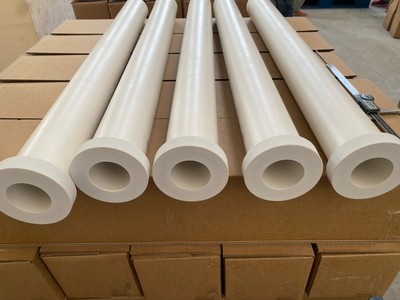
This allows an aluminum titanate riser tube to withstand rapid heating and cooling cycles without cracking. In automotive LPDC production lines - where thermal fluctuation is constant - this property significantly improves operational stability.

Outstanding Thermal Shock Resistance
Automotive casting often involves frequent start-stop cycles. Materials with poor thermal shock resistance may fracture under sudden temperature change.
Al₂TiO₅ ceramic maintains structural integrity even under repeated temperature variations, making it a reliable solution for:
Aluminum titanate riser tubes
Ceramic stalk tubes
Thermocouple protection tubes

Good Corrosion Resistance to Molten Aluminum
Although silicon nitride ceramic provides superior corrosion resistance, aluminum titanate ceramic still performs well in molten aluminum environments.
For many mid- to high-volume automotive casting plants, aluminum titanate offers a balanced solution between performance and cost.
Applications of Aluminum Titanate in Automotive Foundries
In automotive casting facilities, aluminum titanate components are commonly used in:
Low pressure die casting riser tube systems
Aluminum wheel casting production lines
Structural aluminum part casting
Furnace temperature protection systems
The stability of the ceramic tube directly affects:
Melt cleanliness
Flow consistency
Casting yield
Equipment downtime
By upgrading to aluminum titanate riser tubes, many foundries report improved process reliability and reduced maintenance frequency.
Aluminum Titanate vs Other Ceramic Materials
When selecting ceramic components for LPDC, foundries typically compare:
Silicon nitride riser tube
Aluminum titanate riser tube
Nitride-bonded silicon carbide tube
Each material has its engineering positioning:
Silicon nitride ceramic – highest strength and longest service life
Aluminum titanate ceramic – best thermal shock resistance
NSiC ceramic – cost-performance balance
For automotive casting operations that prioritize thermal stability and cost control, aluminum titanate remains a highly competitive option.
Industry Upgrade Trend in Automotive Casting
As EV production expands and lightweight automotive components become standard, casting quality requirements continue to increase.
Automotive manufacturers now demand:
Lower inclusion rate
Higher structural integrity
Stable LPDC performance
Predictable maintenance cycles
Under these conditions, advanced ceramic riser tubes - including aluminum titanate - are replacing traditional metal solutions across global foundries.
This material upgrade is no longer optional; it is part of the broader modernization of die casting systems.
Conclusion
Aluminum titanate ceramic has become an essential material in modern automotive casting applications.
Its unique combination of low thermal expansion, strong thermal shock resistance, and stable performance in molten aluminum environments makes it particularly suitable for LPDC riser tube systems.
As the automotive industry continues shifting toward lightweight aluminum components, aluminum titanate will remain a key technical ceramic supporting casting efficiency, stability, and long-term cost control.