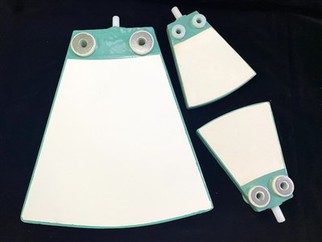
As global mining operations scale up throughput to meet the increasing demand for critical industrial minerals, processing plants are pushing fluid transport velocities to record highs. Moving millions of tons of abrasive slurry containing iron ore, gold tailings, copper concentrates, or coal waste takes a heavy toll on piping networks. Under these extreme conditions, standard carbon steel and high-alloy metal components often experience rapid wall thinning and early failure.
To eliminate expensive unscheduled downtime and lower maintenance costs, Engineering, Procurement, and Construction (EPC) firms and site maintenance managers are changing their procurement standards. This operational shift has driven a significant increase in the global adoption of high alumina ceramic tubes for abrasion control in critical material transport lines.
The Root Problem: Joint Erosion in Fragmented Pipe Linings
While segmented ceramic tiles are effective for large-diameter infrastructure, smaller and medium-sized high-velocity slurry pipelines present a different engineering challenge: joint erosion.
Segmented Lining: [======] [======] [======] <-- Epoxy joints vulnerable to fine-particle wash.
Monolithic Tube: [========================] <-- Seamless, ultra-smooth bore; zero joint risk.
In pipelines lined with individual segmented tiles, high-velocity, fine-particle slurries can slowly wash away the polymer epoxies used in the joints. Once the adhesive is compromised, abrasive particles wedge behind the tiles, eventually causing them to dislodge and expose the outer steel shell to immediate failure.
To solve this vulnerability, pipeline design engineers are increasingly specifying monolithic, seamless alumina ceramic tube inserts for high-wear circuits.
Material Science: Why High-Purity Alumina Extends System Lifespan
The technical advantages of choosing a monolithic ceramic lining over traditional metallurgy or rubber linings are rooted in the physical properties of advanced industrial ceramics.
Comparative Engineering Data
| Material Performance Metric | Standard Carbon Steel (Q235) | High-Chromium Cast Iron | Shandong Anda High Alumina Ceramic (Al2O3≥92%) |
| Mohs Hardness | 4.0 - 5.0 | 6.0 - 6.5 | 9.0 (Surpassed only by diamond) |
| Rockwell Hardness (HRA) | ≤50 HRA | 60 - 65 HRA | ≥85HRA |
| Acid & Alkali Resistance | Poor (Corrodes easily) | Moderate | Excellent (Chemically inert) |
| Wear Life Cycle Factor | 1.0 (Baseline) | 2.5 - 3.0× Base | 10 - 20× Longer Lifespan |
Classified as an advanced technical ceramic, high-purity alumina ($Al_2O_3$) features an exceptionally tight ionic and covalent crystalline structure. Compacted using advanced isostatic pressing and sintered at temperatures exceeding $1700^\circ\text{C}$, it achieves a Mohs hardness of 9.0.
Because this ceramic matrix is significantly harder than the silica, quartz, and heavy metal ores suspended in mining slurries, the particles cannot scratch or groove the surface. Furthermore, because alumina is completely oxidized during manufacturing, it is entirely chemically inert. This property eliminates the erosion-corrosion synergy that often accelerates the failure of bare steel pipes in acidic mine water.
To review full laboratory testing data on erosion rates under different slurry impact angles and fluid transport velocities, read our comprehensive industry whitepaper: Ultimate Guide to Alumina Ceramic Pipe Liner for Mining Wear Protection.
Operational Benefits: Improving Fluid Dynamics and System Reliability
Integrating a seamless alumina ceramic tube architecture into a mining facility's transport network offers distinct operational advantages:
Zero Internal Joints: Eliminating seams prevents localized turbulence and blocks fine particles from degrading the underlying bonding agents.
Reduced Hydraulic Friction: The ultra-smooth internal bore of an isostatically pressed tube lowers flow resistance, reducing pressure drops across the line and decreasing the energy required by slurry pumps.
Predictive Maintenance Windows: Because high alumina ceramics wear at a slow, predictable rate, site engineers can align pipeline inspections with scheduled annual plant turnarounds, reducing unplanned pipeline downtime by up to 70%.
To view complete dimensional blueprints, thickness options, and mechanical performance parameters for these monolithic wear components, browse our dedicated technical ceramic product portfolio.
Mitigating Risk with Precision Engineering and Verified Supply Chains
For cross-border mining procurement managers, investing in advanced wear mitigation is only effective if the components are manufactured to exact dimensional tolerances. Achieving a perfect drop-in fit inside a steel casing requires a highly controlled manufacturing process.
Engineered Solutions by Shandong Anda Industrial Co., Ltd.
Operating from a 10,000-square-meter facility in Zibo, Shandong Province-the center of China's industrial ceramic manufacturing sector-Shandong Anda Industrial Co., Ltd. combines 15 years of heavy-industry export experience with strict ISO 9001 quality management protocols.
Our team of 6 dedicated material technicians and 60 skilled production specialists custom-engineers high-density ceramic linings tailored precisely to your plant's specific CAD drawings. From straight monolithic spools to custom-angled directional elbows, Anda delivers verified wear protection that protects your critical assets and reduces your Total Cost of Ownership (TCO).
Engineering Consultation: Don't let predictable metal piping failures compromise your plant's production targets or inflate operational costs. Contact our technical sales division today to schedule a comprehensive wear-life assessment and receive a custom-tailored technical proposal for your operation.