Engineering Challenges in Complex Slurry Pipeline Geometry
ZIBO, CHINA - In modern mineral beneficiation plants, deep-pit tailings backfill networks, and hydrometallurgical processing facilities, slurry conveyance is rarely a straight-line operation. Designing efficient transport systems requires routing high-density, multi-phase solid-liquid mixtures through tight spatial envelopes, including directional elbows, reducing tees, distributor manifolds, and vertical-to-horizontal drop shafts. While straight pipeline spools exhibit predictable, uniform sliding friction, recent computational fluid dynamics (CFD) research and field failure analyses reveal that complex geometric fittings experience localized erosion rates up to 8 to 12 times higher than adjacent straight sections. For Engineering, Procurement, and Construction (EPC) contractors and plant integrity engineers, solving the destructive fluid-particle dynamics inside these complex pipeline geometries has become a primary operational priority.
Fluid Dynamics: Secondary Vortices and Particle Segregation
When high-density mineral slurries-such as iron ore concentrates, bauxite liquor, or cemented paste backfill (CPB)-enter non-linear pipe geometries, the carrier fluid and solid particles behave asymmetrically due to momentum differences. This separation triggers three severe degradation mechanisms:
- Centrifugal Particle Migration & Outer-Wall Impingement: In curved sections such as 45° or 90° directional elbows, the inertia of coarse solid particles (80 > 120um) forces them to cross the fluid streamlines. Particles concentrate against the outer extrados (outer radius wall), shifting the wear mode from low-angle sliding abrasion to high-velocity perpendicular cutting impingement.
- Dean Vortices in Directional Bends: Radial pressure gradients generate counter-rotating secondary flow loops (Dean vortices). These secondary currents drag abrasive fine particles across the inner boundary layer, creating deep, localized helical gouging grooves along the bottom and side quadrants.
- Recirculation Zones at Tee-Junctions and Manifolds: In dividing tees, hydrocyclone distributor headers, and wye-branches, abrupt flow splitting generates localized low-pressure recirculation zones. Solid particles become trapped in stationary vortices, creating concentrated point-wear that can breach standard carbon steel or rubber-lined blanks in less than 12 weeks.
CFD Modeling Insight: Coupled CFD-DEM (Discrete Element Method) simulations demonstrate that increasing fluid velocity above 3.5m/s in a 90° elbow shifts the maximum erosion zone toward the downstream exit quadrant, accelerating localized wall thinning exponentially .
Material Limitations: The Failure of Metals and Segmented Tiles
Standard engineering approaches struggle to deliver long-term reliability inside complex pipeline fittings:
- Ductile Carbon Steel & Hardfaced Alloys: Under continuous particulate impact, ductile steels deform and work-harden, leading to rapid micro-cutting. In acidic or reagent-heavy process circuits, the impact continuously strips the metal's passive oxide layer, accelerating the cycle of erosion-corrosion.
- Cast Basalt Linings: While resistant to pure sliding friction, cast basalt is brittle and prone to structural spalling when subjected to the high impact energy and turbulent pressure pulses common in complex manifold junctions.
- Faceted Flat Ceramic Tiles: Lining curved fittings with standard flat rectangular tiles creates stepped interior seams. These steps disrupt fluid flow, induce micro-cavitation, and allow fine slurry particles to scour out the underlying bonding epoxy, leading to premature tile dislodgement.
Engineered Ceramic Solutions for Complex Geometries
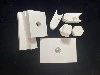
Shandong Anda Industrial Co., Ltd. addresses geometric wear challenges by engineering custom technical ceramic wear components tailored to the exact CAD flow profiles of complex fittings:
- Engineered Radial Elbow Sleeves: Fabricated using isostatically pressed, interlocking arched ceramic segments or monolithic curved sleeves. Sintered at temperatures exceeding 1700°C, high-purity alumina (Al2O392%/95%) and Zirconia-Toughened Alumina (ZTA) achieve a mineral hardness of Mohs 9.0 (85HRA), completely resisting particle cutting.
- Zero-Step Seamless Manifold Inserts: Custom-machined in the green state before firing, ensuring that reducing tees, wyes, and distributor headers maintain a smooth internal hydraulic radius without exposed joint edges.
- Controlled Factory Vulcanization & Epoxy Bonding: Spools are assembled in-house with automated surface shot blasting and thermally cured structural epoxies, ensuring bond shear strengths 15 MPa that withstand dynamic pressure pulsations.
Performance Analysis in High-Stress Complex Pipeline Fittings
The following engineering data compares material performance in a high-velocity gold tailings discharge elbow (DN200, 90° radius, velocity 4.2 m/s, 55% solids):
| Engineering Property | Standard Carbon Steel (Q235) | Cast Basalt Lined Elbow | Anda Custom Alumina/ZTA Ceramic Spool |
|---|---|---|---|
| Surface Mineral Hardness | 4.0 - 5.0 Mohs | 7.0 - 8.0 Mohs | 9.0 Mohs (≥ 85 - 90 HRA) |
| Resistance to Secondary Vortex Wear | Poor (Rapid deep gouging) | Moderate (Surface pitting) | Excellent (Zero surface degradation) |
| Joint Washout Vulnerability | N/A (Welded) | High (Mortar joints degrade) | Zero (CAD-matched tight interlocking) |
| Corrosion-Erosion Synergy Defense | Rapid failure in low pH | Good chemical resistance | 100% Chemically Inert (pH 1–14) |
| Relative Operating Lifespan | 1.0 (Baseline: ~3 Months) | 2.0 - 2.5× Base | 8 - 12× Extended Lifespan |
Quantifying the Operational ROI for Plant Operators
Upgrading complex slurry pipeline geometry to bespoke ceramic-lined spools delivers clear financial and operational advantages:
- F (Features): Pre-engineered, CAD-matched high-alumina and ZTA ceramic segments designed to match complex pipeline bends, reducers, and manifolds with tight joint tolerances.
- A (Advantages): Eliminates the rapid wall-thinning caused by secondary vortices and particle impingement, maintaining a smooth hydraulic boundary layer.
- B (Benefits): Slashes unscheduled pipeline leaks, reduces hydraulic pumping losses across fittings by up to 20%, and extends component replacement cycles to match major planned annual turnarounds.
- E (Evidence): Supported by a 10,000-square-meter manufacturing facility in Zibo, China, Shandong Anda Industrial Co., Ltd. manufactures custom wear-resistant pipeline fittings certified to strict ISO 9001 quality management standards for leading international mining operations.
Solve Your Complex Geometry Wear Challenges Today
Prevent unexpected pipeline breaches, pressure surges, and localized manifold failures from interrupting your mineral processing targets. Our team of 6 specialized material technicians and 60 skilled production specialists custom-engineers high-performance industrial ceramic fittings tailored directly to your site's isometric drawings, slurry rheology, and velocity profiles.
Request a Custom Geometry Wear Evaluation
Contact Shandong Anda's technical engineering team to submit your isometric CAD drawings, review fluid erosion modeling, or receive a complete bespoke ceramic spool proposal.