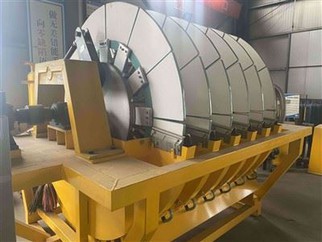
Global environmental mandates on the mining sector have reached unprecedented levels of stringency. Driven by zero-liquid discharge (ZLD) policies and severe corporate liabilities associated with traditional wet tailings dam failures, mining operators worldwide are facing a massive processing challenge. Recent industrial data indicates that modern large-scale mines consume over $2.50 to $5.00 in water procurement and waste management costs per ton of processed ore. To mitigate these overheads, mineral processing infrastructure must evolve rapidly from legacy wet discharge to a modern dry tailings stacking approach.
At the core of this transition is the optimization of solid-liquid separation. High-volume mining filtration plants are systematically phasing out high-wear belt presses and energy-intensive centrifuges. Instead, they are integrating high-efficiency disc filter systems utilizing advanced ceramic filter plates to maximize water recovery and achieve stable cake structures.
[ RISK & OVERHEAD ] High Tailings Dam Liability + Soaring Water Costs
↓
[ PRODUCTION UPGRADE ] High-Capacity Ceramic Vacuum Filters
↓
[ VALUE EXTRACTION ] 82-88% Solid Dry Cakes + Direct Recycled Process Water
For a comprehensive engineering analysis on maximizing throughput, optimizing backwash frequencies, and calculating fluid velocity across ceramic matrices, explore our flagship technical guide: The Complete Guide to Ceramic Filter Plates in Mining Filtration: Engineering, Optimization, and Global Trends.
1. The Tailings Crisis: Why Traditional Cloth-Based Filtration Fails
The primary operational bottleneck in dewatering ultra-fine tailings underflows lies in the choice of filtration media. Traditional textile filter cloths are highly flexible and variable, meaning that under continuous mechanical pressure, their pores warp.
Sub-20 micron mineral slimes and clay particles easily wedge themselves inside these cloth fibers. This phenomenon, known as deep-bed particle blinding, quickly cuts structural permeability. In high-tonnage mining operations, cloth-based systems often require complete shutdowns every 150 to 300 operating hours for aggressive chemical washing or expensive replacements.
The clear engineering trade-offs and cost implications of these materials are fully detailed in our technical comparison: Ceramic Filter Plates vs Filter Cloth: Which Is Better for Mining Filtration?.
2. Technical Mechanisms: The Capillary Advantage of Microporous Ceramics
An industrial ceramic filter plate (also known as a ceramic filters disc) completely re-engineers fluid dynamics by utilizing controlled capillary forces paired with sub-surface vacuum extraction.
Absolute Gas-Barrier Hydrophobic Sealing
Advanced ceramic elements are manufactured with a dual-layer structure featuring a surface membrane with ultra-fine pore matrices 0.5-2.0μm).
When the wetted plates are immersed in the tailings slurry basin, the tiny pore radii generate high natural capillary tension. When an internal vacuum pump applies a deep negative pressure of -0.09 -0.098MPa, water flows through the plate with ease.
Crucially, because the breakthrough pressure of these water-filled micropores is higher than the vacuum itself, air cannot pass through the ceramic membrane. The system forms a perfect seal, preventing air bypass. This drastically reduces energy use, as the vacuum pump only works to extract water rather than moving massive volumes of free air.
The Water Casting Drainage Network
To handle the heavy fluid volumes required during high-tonnage tailings processing, modern plates rely on innovations like the Water Casting Process. Developed within Zibo's advanced industrial ceramic engineering hub, this method uses single-body molding and single-body sintering to create a highly porous, stable internal structure.
This technique yields a complex network of interconnected internal paths, where 80% of the total plate volume acts as an active water channel. This structural configuration lowers internal fluid resistance, accelerates filtrate removal, and prevents internal delamination during high-pressure backwashing cycles.
3. Measurable Performance Gains in Mining Water Treatment
Upgrading a tailings dewatering circuit to automated vacuum ceramic filters delivers clear operational advantages for plant managers:
Consistent, Low Cake Moisture: The system reduces final cake moisture down to a stable 8- 12% range for iron, copper, and gold tailings. This allows for immediate mechanical conveyance and dry stacking without requiring secondary thermal drying equipment.
Ultra-Clear Filtrate Recovery: Because the sub-micron membrane blocks fine slimes, the recovered filtrate contains very low total suspended solids (SS < 20mg/L). This enables the water to be recycled directly back into the mill's processing circuits, optimizing the mining water treatment loop.
Seamless Global Fleet Integration: These engineered plates are built to precise physical tolerances, allowing them to serve as reliable, high-performance replacement parts for major international filter brands such as Roxia and CEC.


4. Driving Strategic Viability for Modern Mines
As global environmental compliance and operating costs (OPEX) become increasingly critical factors for mining viability, managing tailings processing efficiently is a major priority. By choosing high-performance alumina or silicon carbide ceramic filter plates, modern mineral processing plants can ensure reliable throughput, low maintenance overheads, and efficient water recovery for sustainable operations.
To review detailed structural drawings, exact geometric parameters, and tailored material options for upgrading your Roxia or CEC systems, view our official technical catalog:
👉 ANDA Industrial Vacuum Ceramic Disc Filter Plate Solutions